When you stop looking.

Sharing another wonderful article by my super hero Dr Joe

When You Stop Looking and Start Becoming

All creation begins with a thought. When we become aware that we don’t have something we want, we naturally experience the emotion of lack from not having what we desire. This is how we begin creating through our imagination. It is our natural, innate propensity to be creators at play. The more we think about these things and imagine what it would be like to have them, the more our brain naturally starts creating pictures and images of what our future could look like. This is what it means to dream the dream of the future.

This process begins in the frontal lobe—the brain’s creative center. When it switches on, it begins recruiting circuits in the rest of the brain that are related to things we’ve learned and/or experienced in our lives. As a result, our brain begins firing in new sequences, patterns, and combinations. Each time we do this we’re not only changing our mind—because the mind is the brain in action—but we’re beginning to change our brain.

If we keep thinking about making that future become a reality, we naturally begin to insert ourselves into the scene of our future. According to research on mental rehearsal, once we immerse ourselves in that scene, changes begin to take place in our brain. Therefore each time we do this, we’re laying down new neurological tracks (in the present moment) that literally change our brain to look like the brain of our future. In other words, the brain starts to look like the future we want to create has already happened.

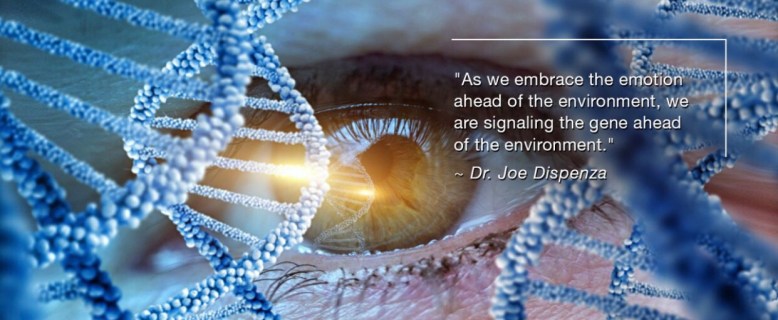
If we are truly engaged in this process with passion, we might begin to emotionally experience our future through thought alone. In fact, when we are feeling the emotions of our future—whether that’s gratitude, joy, freedom, abundance, enthusiasm, love, and so on—the creative thoughts in your mind can become the experience. As the body receives the chemical signals of these emotions, essentially the body is receiving the signal that the event has already occurred. If the latest research on epigenetics tells us that the environment signals the gene, and the end product from an experience in the environment is an emotion, as we embrace the emotion ahead of the environment, we are signaling the gene ahead of the environment.

Since genes make proteins and proteins are responsible for the structure and function of the body, if it’s done properly we reap the physical results of these actions and begin to embody our future before it’s made manifest. In a sense, we are biologically wearing our dream.

No matter what we’re trying to create in our lives, whether it’s a relationship, a job, a house, health, a calm mind, or a peaceful heart, in thinking about those things and desiring them, we may know what we want in thought, however many times we experience the emotion of lack in the way we feel. That’s because we’re conditioned to live in a 3D world and we want immediate gratification or relief from that lack. In other words, if we don’t get what we want right away, the lack from not experiencing it with our senses reinforces the absence of not having it.

Here-in lies our biggest challenge as creators. The lack we live by each day when we notice it hasn’t happened yet causes us to feel separate from our dreams and we no longer believe in our future any longer. That’s because we are back in the emotions of our past—and we can’t see our future through the window of our past. When we live in lack while we are still creating our future, over time we stop creating and wait for something outside of us to take away the lack we feel inside of us. But it is the lack that is keeping our dreams at arm’s length in the first place.

But what if you lived by the emotions of your future every day? You would feel like your future has already happened and less likely to be separate from your dreams. That’s how we believe in a future we have not yet experienced with our senses, yet we keep it alive in our mind and body.

By the wonderful Dr Joe Dispenza whose wisdom is growing exponentially

Sending love and blessings to you all and to this wonderful amazing planet xxx

Five mood boosting secrets.


Sharing an interesting article from Patrick Holford

Your mood has as much to do with what you eat as what you think. That’s because the brain is totally dependent of key mood-boosting nutrients. In a study at Oxford University, where 15 women were given food lacking the essential mood-boosting nutrient, tryptophan, ten started feeling more depressed within 7 hours. Here are the five key nutrients you need to feel good every day.

THE CHROMIUM FACTOR

If you feel like you never get enough sleep, often feel sleepy in the day, crave carbohydrates and sweet foods, and often feel very moody and sensitive you might have what’s called ‘ atypical depression’. One of Americas’ top professors of psychotherapy, Malcolm MacLeod, discovered something unexpected that turned his patients around. It was an inexpensive chromium supplement. Chromium is an essential mineral that helps stabilise blood sugar. It comes in 200mcg. Taking two, thats 400mcg, in the morning, and one at lunch has proven, in a double blind study to relieve ‘atypical’ depression in days. Of course, we need and welcome more research but chromium can work that fast if it’s your missing factor. It has no side-effects so why not try it? Chromium is in whole foods and lost in the refining process. So, stay away from the white stuff, especially sugar.

WHY ESSENTIAL FATS ARE ESSENTIAL

Extraordinary as it may sound, you can actually predict a country’s murder rate, as well as its depression and suicide rate simply by knowing its seafood intake. That’s what Commander Joe Hibbeln, chief psychiatrist for the US navy, discovered when he pooled the data from numerous countries. Fish, especially oily fish such as salmon and mackerel, is very high in omega 3 fats. These help boost serotonin, that’s the brain’s feel good chemical.

According to Dr Joseph Hibbeln, ‘It’s like building more serotonin factories, instead of just increasing the efficiency of the serotonin you have.’ A recent survey in Norway found the same thing. Those who consumed cod liver oil, another rich source of omega-3, had the lowest incidence of depression, and the longer a person had been taking it the less likely they were to be depressed.

The most comprehensive review and meta-analysis of 19 trials on patients with mild and major depression ‘concludes that ‘the use of omega-3 fats is effective’ both in patients with major depressive disorder and milder depression’. (Grosso, PLoSOne, 2014) Most effective studies give 1,000mg of EPA. Lowest effect occurs with 300mg combined EPA/DHA. Most studies on antidepressant drugs report something like a 15 per cent reduction in depression ratings. Three studies on omega-3s reported an average reduction of 50 per cent – and that’s without side effects. One of the first placebo-controlled trials, by Dr Andrew Stoll from Harvard Medical School, gave 40 depressed patients either omega-3 supplements or a placebo and found a highly significant improvement in the patients on supplements. In the next study, 20 people suffering from severe depression, who were already taking antidepressants but were still depressed, were given either a highly concentrated form of omega-3 factor a placebo. By the third week the depressed patients an EPA rich fish oil supplement were showing major improvement in their mood, whereas those on placebo were not. So you don’t have to wait long for a result. EPA, by the way, is the kind of omega 3 fat that’s helps boost mood the best. That’s secret number 4, supplementing an EPA rich fish oil supplement. We recommend eating oily fish three times a week.

AMAZING AMINOS

Most anti-depressant drugs are said to work because they boost serotonin, the brain’s happy chemical. They do this, not by helping your brain to make more, but stopping it from breaking it down. If you think about it there are three questions you want to ask: am I low in serotonin? If so, why? And what can I do to boost my serotonin level naturally?

The most direct way to raise a low serotonin level is to supplement the amino acid, called 5-hydroxytryptophan, from which it is made. The first study proving the mood-boosting power of 5-HTP was carried out in the 1970s in Japan, under the direction of Professor Isamu Sano of the Osaka University Medical School. He gave 107 patients 50–300mg of 5-HTP per day, and within two weeks, more than half experienced improvements in their symptoms. By the end of the four weeks of the study, nearly three-quarters of the patients reported either complete relief or significant improvement, with no side effects.

Since then many studies have proven 5-HTP to be more effective than SSRI anti-depressants in the prozac generation. There have been 27 studies to date showing positive results. It also helps you get a good night’s sleep. But not everyone benefits because not everyone is low in serotonin. But, if you are, 5-HTP can be very helpful.

Holly is a case in point. She felt that her anxiety, depression and indecision were ruining her life. She constantly felt stressed, had frequent mood swings, she would cry for no reason and was finding it hard to think straight. When we tested her at the Brain Bio Centre her serotonin levels were rock bottom. She was also very low in magnesium, which is one of the essential minerals needed to make serotonin, as well as being vital for good sleep. She was recommended a supplement programme to increase her serotonin, including 5-HTP, B vitamins and magnesium. Very quickly Holly began to feel much better. She started sleeping well, her anxiety reduced and her mood lifted. Her serotonin level normalized and she was amazed at the reduction in anxiety and said it had made a substantial difference and that she felt much more balanced and could see the positive outlook, rather than the negative.

There are other amino acids that can make a big difference to your mood including phenylalanine and tyrosine, from which we make the neurtransmitter noradrenalin, vital for motivation and drive.

GET YOURSELF CONNECTED WITH B VITAMINS

The brain’s feel good neurotransmitters are made from amino acids, and how essential fats make more receptors for these feel good chemicals, but how does the brain turn the food you eat into neurotransmitters? That conversion process is dependent on B vitamins. Most important are vitamin B6, B12 and folic acid. Giving more of these B vitamins often makes you feel more ‘connected’.

In one study, depressed people were either given an SSRI antidepressant with folic acid or the SSRI with a placebo. Nine out of ten of the women taking the SSRI with folic acid had at least a halving in their depression rating.

In older people the most common missing B vitamin is B12. That’s because the older you get the less well you absorb it. In truth, it is wise to supplement extra, certainly once you’re over 50. As well as improving your mood,  it stops your brain shrinking.

But, how do you know whether you need more B vitamins? The best test is something called homocysteine. If your blood homocysteine level, which can be tested on a home test kit, is high, you need more B vitamins. The combination of zinc with TMG (tri-methyl-glycine) also helps lower homocysteine and balance your mood.

Amanda-Jane is a case in point. She was suffering with chronic fatigue and low mood, so she decided to check her homocysteine level. She was shocked when she found her H score was 26 units (your level should be below 7).

She followed  the diet and supplements I recommend in the book and, almost immediately her sleep improved,and within four weeks she had much more energy. Two months later she re-tested her homocysteine level and found it had dropped to 9units. That’s a 64 per cent decrease. Here’s what she said:‘I feel much better. My mood is very positive– no panic or depression. I feel buoyant, energetic and enthusiastic. I’m sleeping much better and my PMS has disappeared.

VITAMIN D – THE SUNSHINE FACTOR

From an evolutionary point of view we are designed to be naked, living outdoors and a lot further South that Europe. In the winter it’s hard to make enough vitamin D, which is made in the skin with direct sun exposure. You don’t make it through glass. The lower your vitamin D level the more depressed you are likely to feel. That’s what researcher at the University of Tromso in Norway found on testing 441 volunteers who were then given a test for depression and also a test for blood levels of vitamin D. The volunteers were then given Vitamin D supplements or placebo.

Tested one year on, those given vitamin D, but not those given the placebos, had lowered their depression ratings substantially. However, you don’t have to wait for a year to get a lift in mood. A study in Australia  found that those given vitamin D supplements had an improvement in mood in only five days.

Daryl, a patient at the Brain Bio Centre,  is a case in point. He found that, particularly during the winter, he felt very low, irritable and angry, and was suffering from what he described as ‘brain fog’. His blood tests showed verylevels of both vitamin D and essential fats. We gave him supplements, and recommended eating more oily fish. He quickly noticed what he described as a ‘massive improvement’ in his symptoms. He was no longer waking with headaches for the first time in six years, instead feeling thoroughly refreshed.

Fantastic article by Patrick.

By sharing knowledge from a vast array of sources enables us as individuals to take back the reins to our own health. Thus building a likeminded community with a focus on health rather than disease.

Sending love and blessings xx

The science of songs: how does music affect your body chemistry?

Classical music makes shoppers buy more. Gentle tunes can cure insomnia. How? Writer, composer and science lecturer John Powell explains

Like many music lovers I’ve always had a fascination with the emotional power. How can a combination of sounds make all the hairs on your arms stand on end, or make you cry? I’ve always enjoyed reading newspaper and magazine articles about the psychological effects of music, but apart from the general conclusion that “music is magical”, they rarely provide any scientific answers.

But there are answers as to why music has such power over us. Since the middle of the 20th century, music psychologists have been carrying out a wide range of fascinating research into how our brains and bodies respond to music – but most of this has been relayed to us in formal scientific language, so I thought it would be a good idea to gather together the most interesting facts and theories from this large body of work and present them in plain language for the general reader.

I spent four years gathering information for my book, Why We Love music, reading textbooks and papers packed full with phrases like “spectral structure and harmonic syntax” and “amplitudes of transglottal airflow”. Translated into conversational English, the science – I think – is of interest to everyone who loves music (and even those few of us who don’t). For example, experiments have demonstrated that music is extremely effective at curing insomnia; that shoppers spend more money in stores playing classical music; and that communal singing helps humans to bond with each other by releasing oxytocin into our system – the same chemical we experience during sex or breast-feeding.

My main problem in preparing the book was deciding which subjects to leave out. There are lots of interesting snippets I wish I could have included but they simply didn’t fit into any of the chapters, like how rock singers only appear to be singing louder when they reach the climax of their songs. What they are actually doing is putting more emotional stress into their voices, which we pay more attention to and so they sound louder than they are.

The effect of music on our body chemistry is particularly fascinating to me. Our bodies effectively contain an internal pharmacy that dispenses various chemicals to help us deal with life’s challenges. For example, if you’re in a dangerous situation, you’ll receive a shot of adrenaline to give you energy, and if you do something which is good for you, you get a dose of serotonin (which encourages you to do the same thing again). Research has revealed that music holds the keys to your body’s pharmacy, and can promote or suppress the release of these chemicals. For example, loud and rhythmic music can increase your adrenaline levels, which will help to keep you awake during a long, boring drive. But in the case of insomnia, relaxing music can help you drop off to sleep by reducing the amount of the ‘vigilance chemical’ Noradrenaline in your system. Just half an hour of calming classical music at bedtime can help you to re-establish a healthy sleep pattern – I’d suggest lute music, like Nigel North’s Cantabile. On that note, sweet dreams!

Extract

Professors North and Hargreaves put music speakers on the top shelf of an end-of-aisle wine display in a supermarket to see if different sorts of music could influence the choices we make. The display consisted of four shelves, each of which had a French wine on one side and a German wine on the other. The wines on each shelf were matched for price and sweetness/dryness so there was a fair competition between the two countries.

Then all they had to do was change the music occasionally and monitor which wines were bought when each type of music was playing.

The results were astonishing:

With no music playing the French wine was slightly more popular than the German. However, when they played German music through the speakers the German wine sold twice as fast as the French stuff.

When they played French music the French bottles sold five times as fast as the German ones.

This implies that we are as helpless as krill in the path of a blue whale as far as marketing music is concerned. And the effect is subconscious – only one in eight of the wine buyers realised that the music had influenced their choice.

More about this book

In “Why You Love Music,” John Powell, a physicist who has also studied musical composition, offers an array of answers that mainly reflect his scientific background. He conveys some basic musical information painlessly, including tuning and scales, the construction of melodies, and elements of timbre and key. His writing is chatty and unpretentious; he is informal and down-home, at times quite funny. If you have ever felt intimidated by music and its terminology of whole and half steps, scales and chords, this book will put you at ease. – Peter Pesic Wall Street Journal.

Article shared from the Guardian Newspaper

Sending love and Blessings xxx

Is pain real ?

Pain feels like a fast stab wound to the heart. But then healing feels like the wind against your face when you are spreading your wings and flying through the air. We may not have wings growing out of our backs, but healing is the closest thing that will give us that wind against our faces.

~C. Joybell

Interesting article by Dr Brannon Frank titled “Pain is not just in the body, but in the mind of the beholder”

Do you remember growing up, going to the doctor’s office to get a vaccine shot —only to be crippled by the thought of having a sharp needle stuck in you? But for some strange reason, when your doctor took your attention off of the shot and onto whatever they were saying; the pain of the needle became unnoticeable. Now did the pain magically go away with your doctor’s kind words or is it that pain goes beyond just the physical sensation attached to it? Neuroscience is illustrating for the world, that perhaps pain is more bio-psychological than we had previously thought. In fact, pain is more in your head than you ever realized.

The Different Types of Pain Explained

We first need to understand that there are different types of pain and how we perceive them is varied as well. For example, there is a difference between tissue-damage pain and the pain associated with a broken heart. Both feel just as intense as the other, the major difference is the origin of the pain and how your neurons interpret the pain associated with the stimulus.

Edwin S. Shneidman Ph.D., founder of the American Association of Suicidology, explains that the majority of pain, even physical pain has its roots in the body’s need for help. Dr. Shneidman goes on to say that the sensation of pain is a combination of physiological processes and psychological needs. Needs such as the need for love, freedom, achievement or even the need to avoid embarrassment, shame, and harm.

Another element that contributes to how you feel pain and the reason we all experience it slightly differently, is which needs take priority within our personal lives. Harvard University Psychologist Henry Murray enlightened the psychological community by explaining that there are no concrete forms expressing the caliber of someone’s pain. The only legitimate method is by gauging someone’s reactions to pain and what they have to say about what they are feeling. Henry Murray goes on to say that this phenomenon occurs because each one of us rates our psychological needs differently. Meaning, what is the most important need for me (emotional need) may not be the most important need for you (financial need), thus the reason in differing levels of pain.

Another factor that plays into how you perceive pain is your childhood and the experiences of pain as a child. Think about it, if you had never experienced pain before, you would be devastated the first time you broke a bone because you wouldn’t have the gained wisdom on how to deal with said pain. The same happens if a child is exposed to pain consistently and then reinforced by a negative emotion. This leads to two different types of pain sensitizations.

Peripheral Sensitisation

This type of pain sensitivity has to deal with the inflammation or damage to your bodily tissue. For example, when you get a cut on your finger, you are experiencing peripheral sensitization. During this process, there is a change in the transduction proteins, which are the carriers of messages that affect the nociceptors, or the receptors of your body’s sensory neurons. When you burn your finger, the stimulus is transformed into electrical signals which are then carried throughout your nervous system and up to your brain via these proteins.

Central Sensitisation

During this type of pain something different happens in people: instead of originating from bodily harm, this pain can manifest itself without tissue damage. What happens is that the neurons in your central nervous system become excited more easily —resulting in feeling pain for much longer periods of time and much more easily. The pain that would normally subside after the initial stimulus still lingers around, eventually leading to chronic pain.

The Mind-Body Connection To Pain

Many doctors believe that disorders such as Fibromyalgia; where the patient has nothing physiologically wrong with them, can be tied back to central sensitization. I spoke with the former President of the Austin Pain Society, Dr. Brannon Frank, in order to better understand the mind and pain connection. After several discussions about single-case patients, Dr. Frank explained to me that the majority of his patients that come complaining of chronic stress usually begins with a life story.

Whereas athletes and other patients who have recently suffered tissue damage can immediately pinpoint the exact origin of pain and typically explain the situation behind the accident. Fibromyalgia patients and others suffering from chronic pain paint a picture of great emotional distress.  Dr. Frank goes on to tell me that more often than not, the patients suffering from severe chronic pain, tell the story of their lives where they recently divorced, lost a loved one, or are undergoing severe depression.

This is a real life example of how pain is not just in the body, but in the mind of the beholder. So the next time you find yourself battling chronic pain or a bad back before you run to your physical therapist — take a long and hard look at your life. Are you suffering from the loss of something valuable in your life or are you genuinely physically hurt? The answer won’t be easy or completely obvious, but I can tell you this much, how you react to the pain makes all the difference. It truly, may be all in your head.

Sending love and blessings xx

Happiness

If you want happiness for an hour, take a nap. If you want happiness for a day, go fishing. If you want happiness for a year, inherit a fortune. If you want happiness for a lifetime, help somebody.

– Chinese Proverb

sending love and blessings xx